
What Is Unsupervised Learning? A Beginner’s Guide
Learn what unsupervised learning is, how it uses unlabeled data, its main types, real uses, limits, and how it differs from supervised learning.
 Oct 29, 2026Published
11 min readReading time
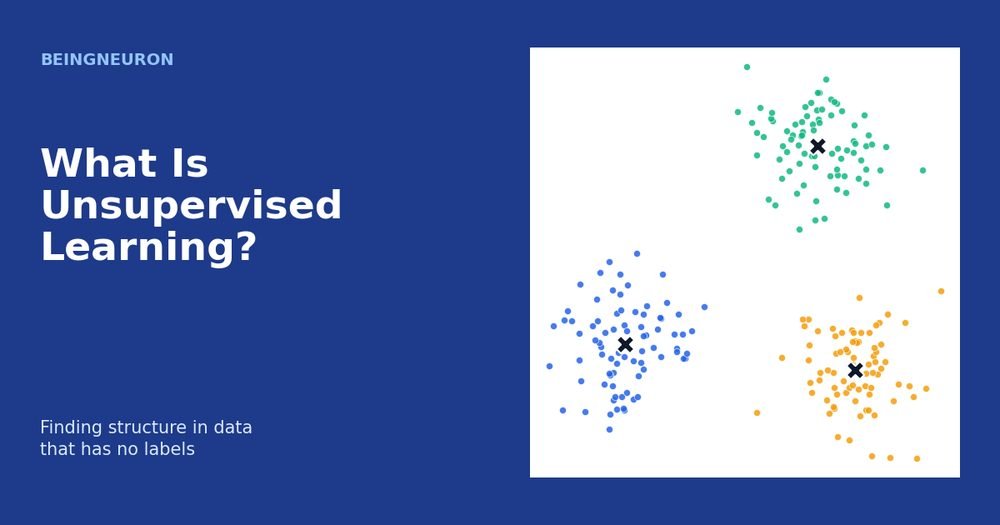
Unsupervised learning is a type of machine learning where an algorithm studies data that has no labels and tries to find structure in it on its own. Nobody tells the model what the correct answer is. The model looks at the features of each example, compares examples with each other, and reports what it finds: groups, patterns, unusual items, or a simpler way to describe the data.
This guide explains unsupervised learning from the beginning. You will learn what unlabeled data is, how the main families of algorithms work, where the technique is used, how it differs from supervised learning, and where it can mislead you. The guide also includes a short Python example you can run in a minute. It is the first article in a ten-part BeingNeuron series that ends with a complete customer segmentation project.
What Is Unsupervised Learning?
Machine learning algorithms learn from data. The kind of data they receive decides the kind of learning they do.
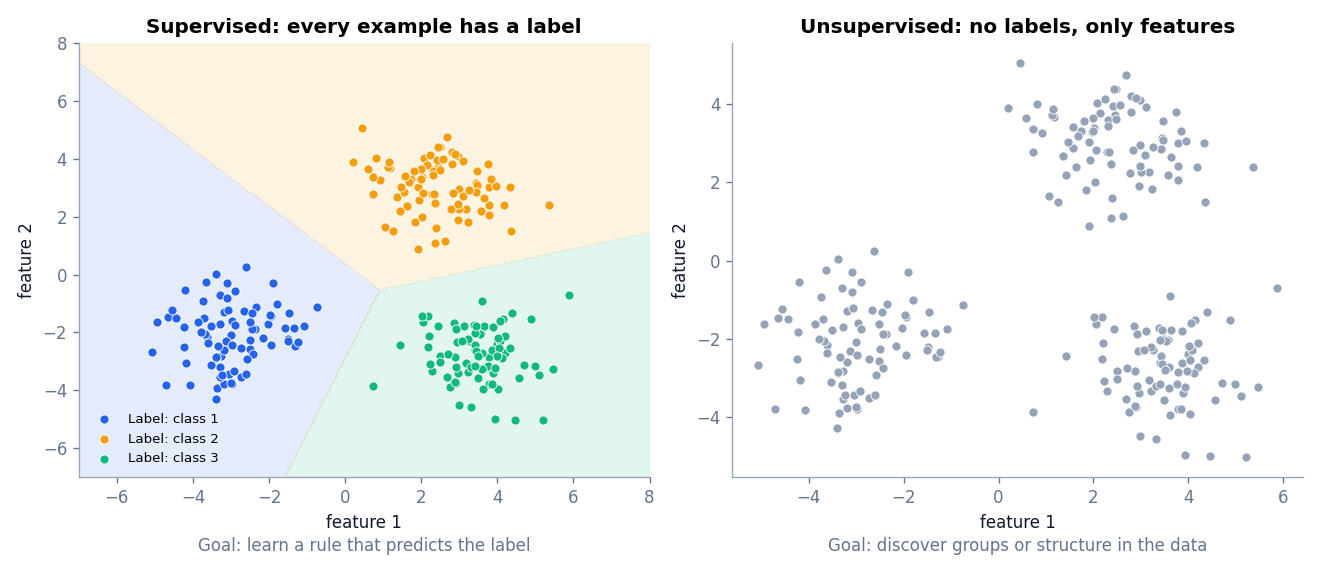
In supervised learning, every training example comes with a label. A photo is tagged “cat” or “dog”. An email is marked “spam” or “not spam”. The model learns a rule that maps the input to the label, so it can predict labels for new inputs.
In unsupervised learning, the labels do not exist. You only have the inputs. The algorithm has to decide for itself what is interesting about the data. Instead of predicting a known answer, it describes the data: which examples are similar, which are strange, and which features carry most of the information.
Formally, a supervised dataset is a set of pairs (x1, y1), (x2, y2), …, (xn, yn), where x is a vector of features and y is the label. An unsupervised dataset is only the set x1, x2, …, xn. The missing y is the whole difference.
A useful analogy is a new employee who is handed a warehouse full of unmarked boxes. Nobody explains the categories. The employee opens a few boxes, notices that some contain cables, some contain tools, and a few contain items that fit nowhere, and starts sorting. The sorting scheme comes from the contents, not from instructions. Unsupervised algorithms do the same thing with numbers.
Understanding Unlabeled Data
A feature is a measurable property of an example. For a customer, features might be the number of visits per month and the average basket size. A label is the answer you want to predict, such as “will cancel the subscription”.
Most data in the real world arrives without labels. Stores record purchases, websites record clicks, machines record sensor readings, and hospitals record scans. Adding labels usually needs a person to read, inspect, or tag each item. That work is slow and expensive, so labeled datasets are much smaller than the raw data that organizations collect.
Unsupervised learning works on the raw data directly. That is its main practical advantage.
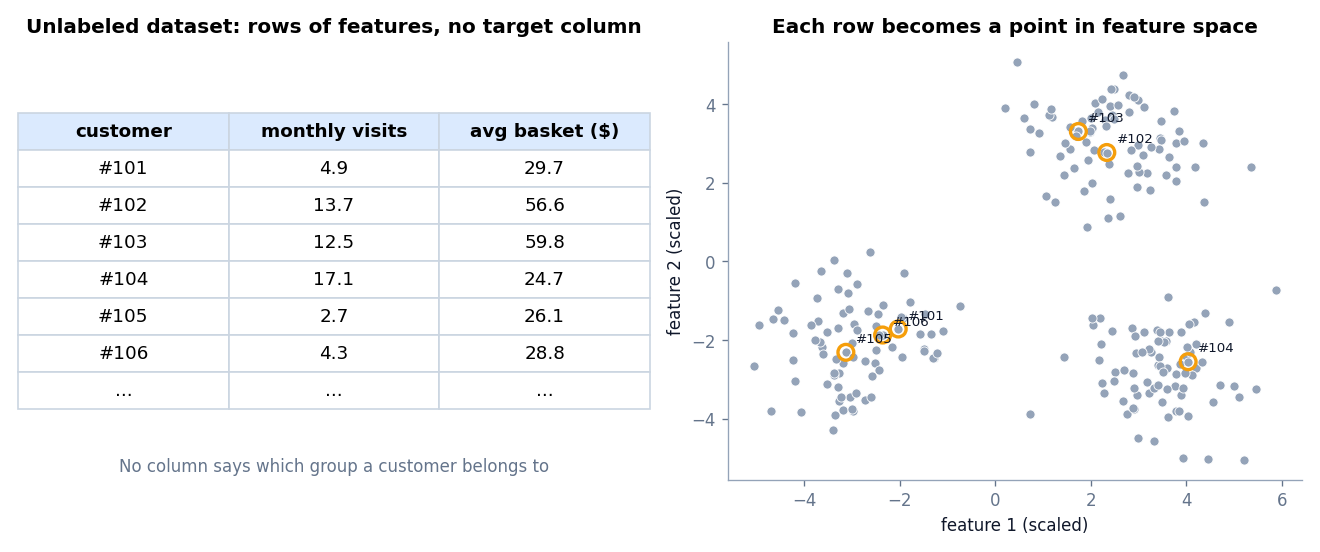
The figure shows what the algorithm actually sees. The table has no column that says which group a customer belongs to. After conversion to numbers, each row is just a point, and the algorithm studies how those points sit relative to each other.
How Unsupervised Learning Works
The details depend on the algorithm, but most methods follow the same outline.
- Represent each example as numbers. Text, images, and categories are first converted into feature vectors.
- Define similarity. The algorithm needs a rule for “close” and “far”, usually a distance such as Euclidean distance.
- Optimize an objective. The algorithm adjusts its internal parameters to score well on a goal that does not use labels. K-means, for example, tries to make points close to the center of their own group. PCA tries to keep as much variance as possible in fewer dimensions.
- Return a description of the data. The output is a set of cluster assignments, a set of new coordinates, a list of anomaly scores, or a fitted probability model.
The next article, How Unsupervised Learning Works: Clustering, Patterns, and Data Structure, goes through features, similarity, and distance metrics in detail.
Main Types of Unsupervised Learning
Clustering
Clustering groups similar examples together. A retailer can group shoppers by buying behavior. The most common algorithms are K-means, hierarchical clustering, and DBSCAN.
Dimensionality reduction
Many datasets have dozens or thousands of features. Dimensionality reduction creates a smaller set of new features that keeps the important information. Principal Component Analysis (PCA) is the standard starting point. Autoencoders do a similar job with neural networks.
Anomaly detection
Anomaly detection finds examples that do not fit the normal pattern, such as a suspicious payment or a failing machine. See Anomaly Detection in Machine Learning for Isolation Forest and Local Outlier Factor.
Density estimation and soft clustering
Some methods model how the data is distributed instead of drawing hard borders. Gaussian Mixture Models give each point a probability of belonging to each group.
Association rule learning
Association methods such as Apriori find items that appear together, for example products that are often bought in the same basket. This family works on transaction data instead of numeric feature vectors and is outside the scope of this series.
Supervised vs Unsupervised Learning
The two approaches answer different questions. Supervised learning asks, “Given this input, what is the output?” Unsupervised learning asks, “What structure is in this data?”
| Aspect | Supervised learning | Unsupervised learning |
|---|---|---|
| Training data | Features and labels | Features only |
| Goal | Predict a known target | Discover structure |
| Typical tasks | Classification, regression | Clustering, dimensionality reduction, anomaly detection |
| Evaluation | Compare predictions with true labels | No ground truth; use internal metrics and domain judgment |
| Data cost | Labeling is expensive | Raw data is enough |
Where semi-supervised and self-supervised learning fit
The line between the two is not always sharp. Semi-supervised learning uses a small labeled set together with a large unlabeled set. Self-supervised learning builds its own labels from the data, for example by hiding a word in a sentence and asking the model to predict it. Large language models are pretrained this way. The training signal comes from the data itself, but the model is still predicting a target, so many authors treat self-supervised learning as its own category rather than classic unsupervised learning.
Real-World Applications of Unsupervised Learning
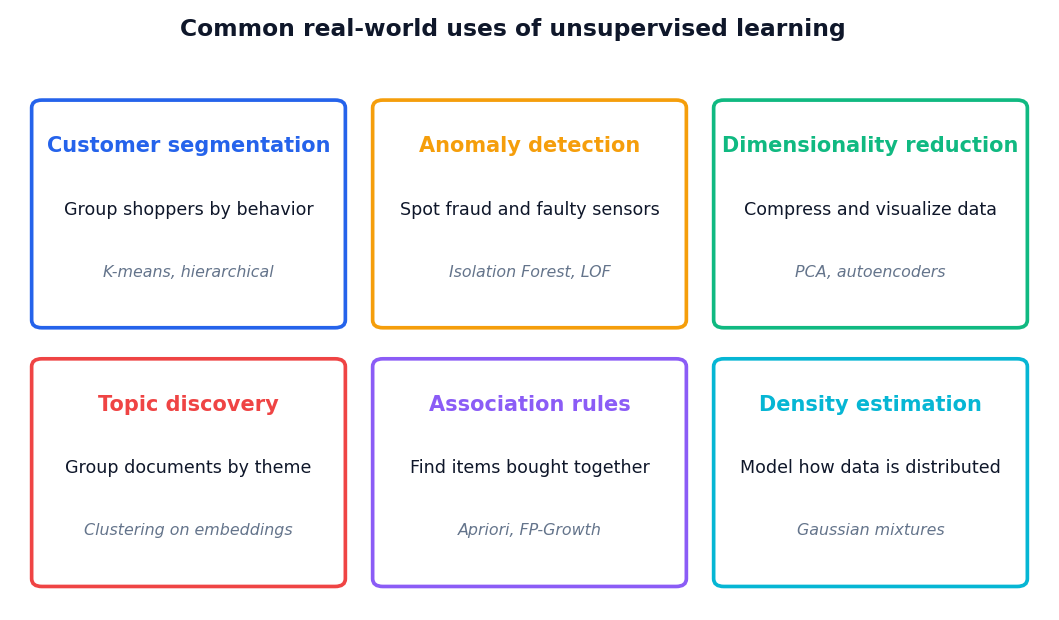
- Customer segmentation. Businesses group customers by behavior and design different offers for each group. The final article in this series builds a full example.
- Fraud and fault detection. Banks and factories look for transactions or sensor readings that differ from the normal pattern, even when no fraud examples have been labeled yet.
- Data compression and visualization. PCA turns a table with 50 columns into two or three columns that can be plotted.
- Document and topic grouping. News sites and research tools cluster articles by topic after converting text to numeric vectors.
- Recommendation support. Grouping similar users or items helps recommender systems suggest relevant products.
- Preprocessing for other models. Learned features from an autoencoder or PCA can feed a supervised model later.
A First Unsupervised Learning Example in Python
The code below creates 300 points from three hidden groups, throws away the group labels, and asks K-means to find three clusters. You need Python with numpy and scikit-learn installed (pip install numpy scikit-learn).
import numpy as np
from sklearn.datasets import make_blobs
from sklearn.cluster import KMeans

# Generate 300 points and throw the true labels away: we keep only the features.
X, _ = make_blobs(n_samples=300, centers=3, cluster_std=1.0, random_state=7)
print("Feature matrix shape:", X.shape)

# Ask K-means to find 3 groups using only the features.
model = KMeans(n_clusters=3, n_init=10, random_state=7)
labels = model.fit_predict(X)

print("Cluster sizes:", np.bincount(labels))
print("Cluster centers:")
print(np.round(model.cluster_centers_, 2))
The call to make_blobs returns both the features and the true group, but the script keeps only the features by assigning the second value to _. KMeans then receives X alone. The parameter n_init=10 runs the algorithm ten times from different starting points and keeps the best result, and random_state makes the run repeatable. Here is the output:
Feature matrix shape: (300, 2)
Cluster sizes: [100 100 100]
Cluster centers:
[[-8.55  5.57]
 [ 9.63  0.54]
 [-1.26  4.38]]
The model found three groups of 100 points each. The centers are the average position of each group. In a real project you would not know whether three is the right number. That question is the subject of the K-means article.
When Should You Use Unsupervised Learning?
Choose an unsupervised method when at least one of these statements is true:
- You have no labels and cannot afford to create them.
- The question is “what is in this data?” instead of “what will happen next?”
- You suspect hidden groups, such as customer types, but do not know their definitions.
- You need to shrink or visualize a wide table before further analysis.
- The events you care about, such as fraud or equipment failure, are so rare that you have almost no labeled examples.
Choose a supervised method when you have trustworthy labels and a precise prediction target. It is also common to combine both: cluster first to understand the data, then train a supervised model that uses cluster membership as one feature.
How Do You Evaluate Unsupervised Results?
Because no answer key exists, evaluation takes more thought than in supervised learning. Practitioners usually combine four checks. First, they compute an internal metric, such as the silhouette score for clusters or the explained variance for PCA. Second, they test stability by running the method again with different random seeds or on resampled data. Third, they inspect the output by looking at plots and summary statistics for each group. Fourth, they ask whether the result supports a decision, such as a different marketing offer for each customer group. A result that is stable, explainable, and useful is far more trustworthy than one that only has a good score.
Advantages of Unsupervised Learning
- No labeling cost. It uses raw data that already exists.
- Discovery. It can surface groups or patterns that nobody thought to look for.
- Exploration. It gives a quick first view of an unfamiliar dataset before you commit to a supervised approach.
- Scale. Many methods run on large datasets without human review of each example.
- Useful features. Compressed representations can improve later models.
Limitations and Challenges
There is no ground truth
The biggest limitation is evaluation. With supervised learning you measure accuracy against known labels. In unsupervised learning, no answer key exists. Internal metrics such as the silhouette score describe how compact and separated clusters are, but a high score does not prove the clusters are meaningful for your business problem.
Results depend on choices
Different feature scaling, a different distance metric, or a different number of clusters can produce very different results from the same data. Always document these choices.
Clusters are not classes
A cluster is a statistical grouping. It does not automatically correspond to a real-world category. Two clusters may split one natural group, or one cluster may mix several. A person with domain knowledge has to inspect and name each result.
Features decide everything
If you cluster customers by features that do not describe behavior, the clusters will not describe behavior. Poor features, unscaled columns, and extreme outliers are common causes of disappointing results.
Common Mistakes and Misconceptions
- “The algorithm finds the true groups.” It finds groups that fit its objective. The objective may not match what you care about.
- “Unsupervised learning needs no preparation.” It needs careful cleaning and scaling, often more than supervised learning.
- “A good score means a good result.” Scores compare options mathematically. Usefulness is a separate question.
- “More clusters are better.” Inertia always falls as you add clusters. At the extreme, every point is its own cluster and the result tells you nothing.
- “Using labels to color a plot makes the method supervised.” Coloring a result by a known column is a way to inspect it. The method is unsupervised as long as the labels are not used to train it.
Frequently Asked Questions
What are examples of unsupervised learning?
Grouping customers by purchase behavior, detecting unusual credit card transactions, reducing a 100-column table to two columns for plotting, and clustering news articles by topic are all examples.
What are the two main types of unsupervised learning?
Clustering and association are often given as the two classic types. In practice, dimensionality reduction and anomaly detection are equally important tasks.
Is unsupervised learning better than supervised learning?
Neither is better in general. Use supervised learning when you have labels and a clear prediction target. Use unsupervised learning when you want to explore data, find structure, or work without labels.
Can unsupervised learning make predictions?
It can assign new data to existing clusters, score new points as normal or unusual, and project new data into a learned lower-dimensional space. It does not predict a human-defined target unless you combine it with a supervised step.
Which algorithm should a beginner learn first?
Start with K-means for clustering and PCA for dimensionality reduction. Both are simple, widely used, and available in scikit-learn.
Conclusion
Unsupervised learning lets you learn from data without labels. It groups similar examples, compresses large feature sets, flags unusual cases, and models how data is distributed. Its strength is discovery, and its weakness is that no answer key tells you whether the discovery is right. Treat every result as a hypothesis that needs inspection.
The next step is to see how these methods actually work. Continue with How Unsupervised Learning Works: Clustering, Patterns, and Data Structure, where features, distance, and similarity are explained step by step.