
Reinforcement Learning vs Unsupervised Learning
Reinforcement learning vs unsupervised learning: compare objectives, feedback, data, algorithms like K-Means and Q-learning, examples, and when to use each approach.
 Nov 6, 2026Published
9 min readReading time
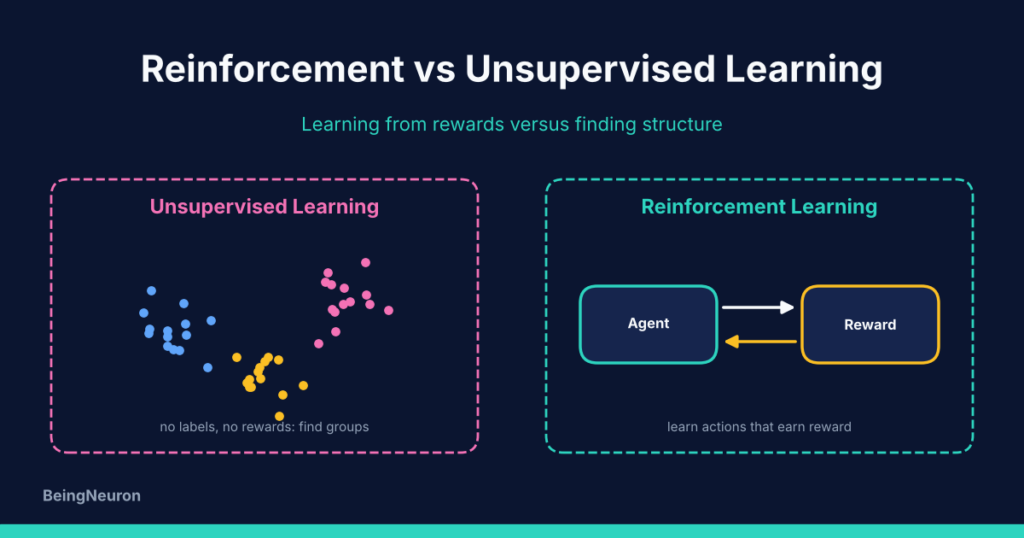
Reinforcement learning and unsupervised learning are often grouped together as the two approaches that do not use labeled examples. That shared trait hides how different they are. One discovers structure in data you already have. The other learns how to act in a world that responds to its choices.
This article explains the difference in objectives, feedback, data, and typical uses, and then shows where the two approaches meet.
Reinforcement Learning vs Unsupervised Learning: An Overview
Unsupervised learning finds patterns or structure in data without explicit target labels, such as grouping similar customers. Reinforcement learning trains an agent to choose actions through interaction with an environment, using reward feedback to maximize long-term return.
Put simply, unsupervised learning describes data, and reinforcement learning decides what to do.
What Is Unsupervised Learning?
Unsupervised learning works with data that has no target labels. The algorithm looks for structure on its own: groups of similar items, directions along which the data varies, unusual points, or compact representations. Common tasks are clustering, dimensionality reduction, density estimation, and anomaly detection. For a full introduction, see What Is Unsupervised Learning?
What Is Reinforcement Learning?
Reinforcement learning (RL) trains an agent that observes a state, takes an action, and receives a reward and a new state from its environment. The agent aims to maximize the total reward collected over time. The pillar guide, What Is Reinforcement Learning?, covers the core components.
How Unsupervised Learning Works
A typical unsupervised workflow has four steps:
- Prepare unlabeled data. Each item is described by features, such as a customer’s age and monthly spend. Scaling features is usually important.
- Choose a structure to look for. For example, a fixed number of clusters, density-based groups, or a lower-dimensional projection.
- Optimize an internal objective. The algorithm improves a measure computed from the data alone, such as how tight the clusters are.
- Interpret the result. A person judges whether the discovered groups or components are meaningful and useful.
The details are in How Unsupervised Learning Works.
How Reinforcement Learning Works
An RL agent runs a loop. It observes the state, picks an action using its policy, receives a reward and the next state, and updates its estimates. Over many episodes it shifts toward actions that lead to higher return. The process, with a numeric maze example, is walked through in How Does Reinforcement Learning Work?
Key Differences Between Both Approaches
Learning without labels is not learning without feedback
It is tempting to say unsupervised learning has no feedback, but that is imprecise. Unsupervised algorithms still optimize an objective. K-Means minimizes the total squared distance from points to their cluster centers. PCA keeps the directions that preserve the most variance. An autoencoder minimizes reconstruction error. What is missing is an externally supplied target, either a label per example or a reward from an environment. The objective comes from the data itself.
Describing data vs choosing actions
Unsupervised output is a description: clusters, components, or scores. RL output is a policy, a rule for acting.
Passive data vs interactive experience
Unsupervised learning analyzes a dataset that exists already, and the algorithm does not change what data appears. An RL agent’s actions change what it experiences next.
Evaluation
RL has a clear performance measure: return. Unsupervised results have no single correct answer. They are judged by internal measures (such as silhouette score), stability, or how useful they are for a downstream goal.
Detailed Comparison Table
| Aspect | Unsupervised learning | Reinforcement learning |
|---|---|---|
| Learning objective | Discover structure, reduce dimensions, find anomalies, or model the data | Learn a policy that maximizes cumulative reward |
| Training data | Unlabeled dataset, usually collected beforehand | Experience generated by interaction (or logged experience in offline RL) |
| Feedback | No external feedback; the algorithm’s own objective is computed from the data | Reward and next state returned by the environment |
| Rewards | Not used | Central; they define the goal |
| Labels | None | None for actions; rewards stand in as evaluation |
| Environment interaction | None | Core requirement (real, simulated, or logged) |
| Optimization process | Minimize or maximize a data-based objective, for example within-cluster distance | Estimate values or adjust a policy to increase expected return |
| Algorithms | K-Means, DBSCAN, hierarchical clustering, PCA, Gaussian mixtures, autoencoders | Q-learning, SARSA, DQN, PPO, A2C, DDPG |
| Applications | Customer segmentation, anomaly detection, data compression, exploratory analysis | Game playing, robot control, resource management, language model tuning |
Clustering vs Reward-Based Learning
Clustering asks, “Which items resemble each other?” It uses a similarity or distance measure and returns group assignments. Nothing in the data says the groups are correct. They are useful if they reveal something a person can act on.
Reward-based learning asks, “Which action should I take here to do well over time?” It uses a reward to rank outcomes and returns behavior. Clustering has no notion of sequence or consequence, and RL has no notion of grouping items by similarity unless the designer builds it in.
Practical Example: Customer Segmentation vs Game-Playing Agent
Customer segmentation (unsupervised). A retailer has records with age, purchase frequency, and average spend, and no labels. K-Means with three clusters might separate occasional low-spend shoppers, regular mid-spend shoppers, and frequent high-spend shoppers. A marketer reads the groups and designs campaigns. The algorithm never acts. See the hands-on Customer Segmentation with Python project.
Game-playing agent (reinforcement). In our recurring maze, the agent starts with no knowledge, moves, receives −1 per step and +10 at the goal, and gradually learns a short route. Nothing is being grouped. The output is behavior, and the data the agent sees depends on the moves it makes.
Common Unsupervised Learning Algorithms
K-Means
K-Means picks k cluster centers, assigns every point to the nearest center, moves each center to the mean of its points, and repeats until assignments stop changing. It minimizes J = Σ ‖x − μk‖², the sum of squared distances from points x to the center μk of their cluster. You must choose k in advance. See K-Means Clustering Explained.
DBSCAN
DBSCAN groups points that sit in dense regions. A point is a core point if enough neighbors lie within a radius; clusters grow by linking core points, and isolated points are labeled noise. It finds clusters of arbitrary shape and needs no preset number of clusters. See DBSCAN Clustering Explained.
Hierarchical Clustering
Agglomerative hierarchical clustering starts with each point as its own cluster and repeatedly merges the two closest clusters. The merge history is drawn as a dendrogram that you can cut at any level. See Hierarchical Clustering Explained.
PCA
Principal component analysis finds orthogonal directions along which the data varies most and projects the data onto the first few. This reduces dimensionality while keeping as much variance as possible. See PCA Explained with Python.
Common Reinforcement Learning Algorithms
Q-Learning
Learns a table of action values, updating each toward the reward plus the discounted best value of the next state. It is off-policy and suits small discrete problems.
SARSA
Similar to Q-learning, but it updates using the action actually taken next. This makes it on-policy, so it accounts for the agent’s own exploration.
DQN
Deep Q-Network replaces the table with a neural network so the agent can handle high-dimensional inputs such as images.
PPO
Proximal Policy Optimization improves a policy directly while limiting how far each update can move it, which helps training stay stable.
Details on each are in the pillar guide.
Can Unsupervised Learning and Reinforcement Learning Work Together?
Yes. Unsupervised methods often prepare the ground for RL.
- State representation. PCA or an autoencoder can compress large observations, such as images, into a smaller state that is easier for an agent to learn from.
- Clustering to simplify states. Similar situations can be grouped so the agent learns one decision for the group.
- Curiosity-driven exploration. Some methods add an intrinsic reward based on how surprising an outcome is, for example the prediction error of a learned model (Pathak et al., 2017).
- Anomaly detection. Unsupervised anomaly detection can flag unusual states that a system should treat carefully.
Self-supervised learning, where a model creates its own training targets from the data, is a related idea and is generally discussed separately from both classical unsupervised learning and RL.
Advantages and Limitations
| Unsupervised learning | Reinforcement learning | |
|---|---|---|
| Advantages | Needs no labels; useful for exploration; stable, mature algorithms | Optimizes sequences of decisions; learns from interaction; can find new strategies |
| Limitations | Results are hard to validate; sensitive to features, scaling, and settings; produces no actions | Needs much experience; depends on reward design; training can be unstable |
When Should You Use Each Approach?
- Use unsupervised learning to explore a dataset, segment users, compress features, or detect outliers when no labels exist.
- Use reinforcement learning when a system must make a series of decisions, each affecting the next situation, and you can define a reward and let the agent practice safely.
- Use supervised learning if you have labeled examples of the answer you want. See Reinforcement Learning vs Supervised Learning.
- Combine them when raw inputs are high-dimensional or exploration is difficult.
Frequently Asked Questions
Is reinforcement learning a type of unsupervised learning?
Not usually. Although neither uses labeled targets, RL is generally treated as a separate paradigm because it learns from reward feedback gained through interaction.
Does unsupervised learning use rewards?
No. It uses objectives computed from the data, such as distances or reconstruction error.
Can reinforcement learning cluster data?
RL is not designed for clustering. You could frame clustering as a decision problem, but standard clustering algorithms are simpler and more effective for that task.
Which is harder to evaluate?
Unsupervised learning is often harder to evaluate because there is no ground truth. RL has a clear metric (return) but can be hard to measure reliably because results vary between runs.
What is the difference between unsupervised and self-supervised learning?
Self-supervised learning creates training targets from the data itself, such as predicting a hidden part of the input. Classical unsupervised learning looks for structure without such prediction targets.
Conclusion
Unsupervised learning reveals structure in data without external targets. Reinforcement learning learns behavior from rewards earned through interaction. Both avoid labeled answers, but they answer different questions: what does this data look like, and what should I do next? To learn more about the learner at the center of RL, read What Is an Agent in Reinforcement Learning?