
Reinforcement Learning vs Supervised Learning
Compare reinforcement learning vs supervised learning: how each learns, labels vs rewards, a comparison table, hybrid methods, and when to choose each.
 Nov 6, 2026Published
10 min readReading time
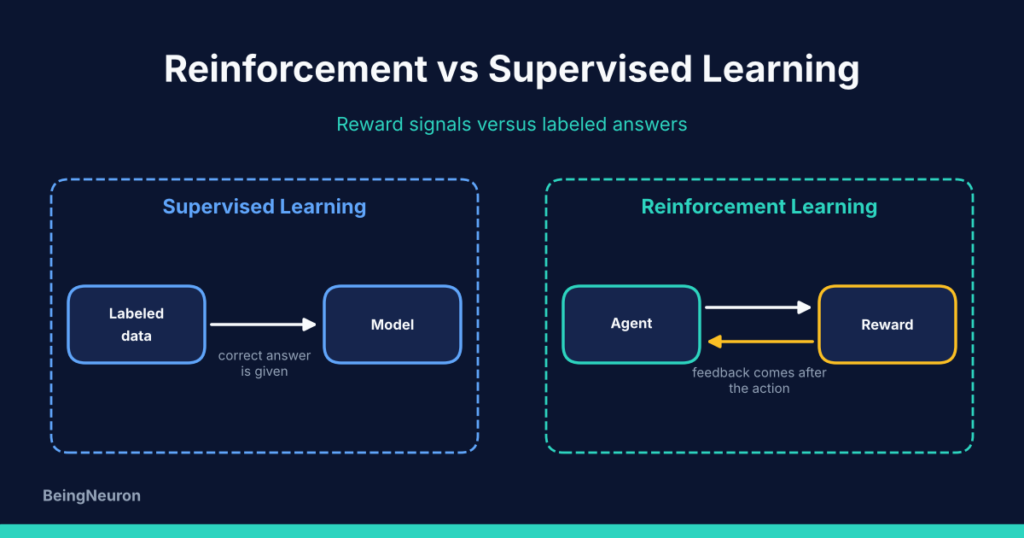
Both reinforcement learning and supervised learning train models from data, yet they solve different kinds of problems and learn in different ways. Confusing them leads to wrong tool choices: teams reach for reinforcement learning when a labeled dataset would do, or force a prediction model onto a problem that is really about sequential decisions.
This article compares the two approaches directly: how each learns, what feedback it uses, where each works best, and how they are combined in systems such as AlphaGo and modern language models.
Reinforcement Learning vs Supervised Learning: An Overview
Supervised learning trains a model on labeled examples so it can predict the correct output for new inputs. Reinforcement learning trains an agent by letting it act in an environment and rewarding outcomes, so it learns which actions maximize reward over time.
A short way to remember it: supervised learning learns from answers, while reinforcement learning learns from consequences.
What Is Supervised Learning?
Supervised learning is a machine learning approach where each training example comes with the desired output, called a label. A model studies many input-label pairs and learns a mapping it can apply to new inputs. Typical tasks are classification (is this email spam?) and regression (what will this house sell for?). Our guide What Is Supervised Learning? covers the basics, and Classification vs Regression separates the two main task types.
What Is Reinforcement Learning?
Reinforcement learning (RL) is an approach where an agent learns to choose actions by interacting with an environment. After each action it receives a reward, and its goal is to maximize the total reward over time. Nobody provides the correct action for each situation. The agent works it out from outcomes. For a full introduction, read What Is Reinforcement Learning?
How Supervised Learning Works
- Collect labeled data. Each example pairs an input (an image, a row of features) with its label.
- Split the data. Part is used for training and part is held back for testing. See Training Data vs Testing Data.
- Choose a model. Options include linear models, decision trees, or neural networks.
- Train by minimizing a loss. The model predicts, the loss measures the error against the label, and an optimizer adjusts the parameters.
- Evaluate on unseen data. This checks whether the model generalizes. See How to Evaluate a Supervised Learning Model.
Mathematically, training aims to minimize the average loss:
L(θ) = (1/N) Σ ℓ( fθ(xi), yi )
- N: the number of training examples.
- xi and yi: the input and label of example i.
- fθ: the model with parameters θ.
- ℓ: the per-example loss, such as squared error or cross-entropy.
How Reinforcement Learning Works
An RL agent repeatedly observes a state, picks an action, receives a reward and a new state, and updates its estimates. Instead of minimizing a loss against labels, it tries to maximize the expected return:
J(π) = Eπ [ r1 + γ·r2 + γ²·r3 + … ]
Here π is the policy (the agent’s way of choosing actions), rt is the reward at step t, γ is the discount factor between 0 and 1, and Eπ is the expected value when following π. The full process, with a worked maze example, is in How Does Reinforcement Learning Work?
Key Differences Between Both Approaches
Type of feedback
Supervised feedback is instructive: it tells the model the right answer. RL feedback is evaluative: it tells the agent how good its choice was, without revealing the best choice.
Timing of feedback
A supervised label arrives with every example. An RL reward may arrive many steps after the decision that earned it, which creates the credit assignment problem: working out which earlier action deserves the credit.
Where the data comes from
In supervised learning the dataset is usually fixed before training. In standard (online) RL, the agent’s own actions determine what data it sees next. A policy that explores poorly collects poor data.
Independence of examples
Supervised learning typically treats examples as independent samples from one distribution. In RL, consecutive experiences are strongly correlated, and the data distribution shifts as the policy changes.
What the model optimizes
Supervised models minimize prediction error on each example. RL agents maximize cumulative reward across a sequence of decisions.
Comparison Table
| Aspect | Supervised learning | Reinforcement learning |
|---|---|---|
| Learning method | Learns a mapping from inputs to outputs using examples | Learns a policy by trial and error through interaction |
| Training data | Labeled dataset, usually collected in advance | Experience generated by the agent (or logged experience in offline RL) |
| Feedback mechanism | Direct, per example, from the label | Reward signal, often sparse or delayed |
| Objective | Minimize prediction error | Maximize cumulative reward |
| Role of labels | Central: they define the correct output | Not used to specify correct actions |
| Role of rewards | Not used | Central: they define the goal |
| Learning process | Minimize loss with gradient-based or tree-based optimization | Estimate values or adjust a policy using observed returns |
| Environment interaction | None required | Core requirement (real, simulated, or logged) |
| Common algorithms | Linear and logistic regression, decision trees, SVM, KNN, gradient boosting, neural networks | Q-learning, SARSA, DQN, PPO, A2C, DDPG |
| Typical applications | Spam filtering, image classification, price prediction, medical diagnosis support | Game playing, robot control, resource management, language model tuning |
Labeled Data vs Reward-Based Feedback
Consider a chess position. A labeled example might say “the best move here is Nf3.” That is a direct answer, and a supervised model can learn to imitate it. A reward-based system instead plays a move, continues the game, and receives +1 for a win or −1 for a loss at the very end. The reward does not say which move mattered. The agent must infer that from many games.
- Labels are expensive to collect. Experts must annotate examples, and annotation errors become model errors.
- Rewards are expensive to design. A poorly written reward can be exploited, a failure called reward hacking.
- Labels limit performance to the labeler. A model trained to copy human moves tends to stay near human quality. An agent optimizing a reward can, in principle, go beyond the examples humans provided.
A Practical Example: Image Classification vs Game Playing
Image classification (supervised). A dataset contains thousands of photos, each labeled “cat” or “dog.” The model sees a photo, predicts a label, and the loss compares it with the true label. Each photo is judged on its own, and the model never changes which photos it will see next.
Game playing (reinforcement). Take a simple arcade game where a paddle bounces a ball to break bricks. The state is the screen, the actions are move left, move right, or stay, and the reward is the score. No label says “move left now.” A move that looks pointless can set up a hit a few seconds later. The agent learns by playing, and its behavior changes what it experiences next.
The first task is a one-step prediction. The second is a sequence of decisions whose effects accumulate. That structural difference, more than any algorithm detail, is what separates the two approaches.
Advantages of Supervised Learning
- Training is usually stable and well understood.
- Evaluation is straightforward: compare predictions with held-out labels.
- Works well with a wide range of mature algorithms.
- Needs no simulator or interaction loop.
- Often more data-efficient when good labels exist.
Advantages of Reinforcement Learning
- Handles sequential decisions where actions change future states.
- Can learn without labeled examples of correct actions.
- Optimizes long-term outcomes instead of single predictions.
- Can discover strategies that were not in any dataset.
Limitations of Both Approaches
| Supervised learning | Reinforcement learning |
|---|---|
| Needs labeled data, which can be costly or biased | Often needs very large amounts of interaction |
| Predicts but does not choose actions on its own | Reward design is difficult and can be exploited |
| Can overfit; see Overfitting vs Underfitting | Training can be unstable and sensitive to settings |
| Performance is tied to label quality and coverage | Unsafe exploration is a risk in real-world systems |
Supervised learning is not limited to one-off predictions. Models for time series and language process sequences all the time. The distinction is the source of feedback: these models learn from given targets, not from the consequences of their own actions.
Can Supervised Learning and Reinforcement Learning Work Together?
Yes, and the combination is common. Supervised learning gives a model a strong starting point from existing data, and RL then refines behavior using a reward.
- AlphaGo. DeepMind first trained a policy network on human expert games with supervised learning, then improved it through self-play reinforcement learning (Silver et al., Nature, 2016).
- Language models. Models are pretrained on large text collections, then fine-tuned on example instructions and responses, and finally refined with reinforcement learning from human feedback. In InstructGPT, a reward model learned from human preference rankings provides the reward.
- Imitation learning. Behavior cloning treats expert demonstrations as labeled examples. It can be a useful starting point for an RL agent, although a cloned policy can drift into situations the demonstrations never covered.
- Offline RL. Instead of interacting live, an agent learns from a fixed dataset of logged experience. This shows RL does not always avoid datasets, but the data still contains actions and rewards rather than correct-answer labels.
Which Approach Should You Choose?
- Choose supervised learning when you have (or can afford) labeled examples and the task is prediction: classify, estimate, or rank. Start with a baseline from Build Your First Supervised Machine Learning Model with Python.
- Choose reinforcement learning when decisions affect future situations, you can define a reward, and you can let the agent practice in a simulator or a safe setting.
- Combine them when demonstrations or text data give a good starting policy and a reward can refine it.
- Consider neither if you only need to find structure in unlabeled data. See Reinforcement Learning vs Unsupervised Learning.
RL is rarely the first thing to try. Simpler methods, including rules or supervised models, are often cheaper and easier to maintain when they are enough for the problem.
Frequently Asked Questions
Is reinforcement learning better than supervised learning?
Neither is better in general. They fit different problems. Supervised learning suits prediction from labeled data, and RL suits sequential decision-making with a reward.
Does reinforcement learning use labels?
Not in the supervised sense. Rewards say how good an outcome was, not which action was correct. Some pipelines still use labeled data in other stages, such as pretraining.
Can supervised learning handle sequential data?
Yes. Time-series and language models are trained with supervised objectives on sequences. What differs is that their targets are given, instead of earned through the consequences of their own actions.
Is reinforcement learning harder than supervised learning?
Usually, yes. It tends to need more experience, more tuning, and careful reward design, and its results are harder to reproduce.
What is behavior cloning?
Behavior cloning trains a model with supervised learning to copy demonstrated actions. It is a supervised method applied to decision-making.
Conclusion
Supervised learning learns from labeled answers and is the natural choice for prediction tasks. Reinforcement learning learns from rewards earned by acting, which suits problems where decisions unfold over time. The most capable systems often use both: supervised learning to start from existing knowledge, and reinforcement learning to improve beyond it. To see how RL differs from learning without labels, continue with Reinforcement Learning vs Unsupervised Learning.