

LLMs

GPU servers and network infrastructure used to run large language model inference
Artificial Intelligence

LLM Inference Explained: How It Works, Bottlenecks, and Optimization

Every time you send a prompt to a chatbot and receive an answer, a large language model (LLM) performs a process called LLM inference. The model uses what it learned during training to understand your input and generate a response. It does not learn new model weights during this process. Instead, it runs its trained parameters to predict the next token, again and again, until it finishes the response. Inference may look simple from the user’s side, but it requires careful coordination between model weights, GPU memory, processors, system memory, and serving software. A powerful GPU does not automatically guarantee fast responses. The system can still slow down because of memory bandwidth, CPU overhead, data transfers over PCIe, or inefficient request scheduling. This guide explains what LLM inference means, how it works, where performance bottlenecks appear, and which techniques engineers use to make inference faster and more efficient. What Is LLM Inference? LLM inference is the process of using a trained large language model to generate predictions or responses from new input data. When you enter a question, the model converts the text into tokens, processes those tokens through its neural network, and predicts what token should come next. For example, imagine asking an AI assistant, “Why do GPUs matter for artificial intelligence?” The model does not retrieve a complete answer from a fixed database. It processes your prompt and calculates a probability distribution over possible next tokens. It selects a token according to its decoding strategy, adds that token to the context, and repeats the process. The model’s learned weights remain fixed during ordinary inference. This is the main difference between inference and training. LLM inference vs. LLM training Aspect Training Inference Main purpose Learn patterns from data Generate predictions or responses Model weights Updated through optimization Normally remain unchanged Typical computation Forward pass and backpropagation Forward pass Memory needs Weights, activations, gradients, optimizer states Weights, activations, and KV cache Performance goals Training speed and stability Low latency, high throughput, and low cost Training a model can require enormous computing resources, but inference also becomes expensive when millions of users send requests. A model may be trained once and then serve requests continuously. That is why inference efficiency is a major part of modern AI infrastructure. How Does LLM Inference Work? Most widely used generative language models follow an autoregressive generation process. They predict one token at a time, using the prompt and previously generated tokens as context. The process has two important stages: prefill and decoding. 1. Tokenization: Converting text into tokens Before the model can process a prompt, a tokenizer converts the text into numerical token IDs. A token may represent a complete word, part of a word, punctuation, or another text unit. For example, the sentence “Inference makes AI useful” is converted into a sequence of token IDs. The exact IDs depend on the tokenizer used by the model. The model processes these numbers rather than ordinary text. 2. Prefill: Processing the input prompt During prefill, the model processes the prompt’s input tokens through its transformer layers. It calculates the attention and other neural network operations needed to build the internal context for generation. It also creates the initial key-value (KV) cache. Because the full input prompt is already available, the model can process many prompt tokens in parallel. This makes prefill relatively compute-intensive, particularly when users submit long prompts or large documents. Prefill strongly affects time to first token (TTFT), which measures how long a user waits before seeing the first generated token. Long context windows, large input batches, and prompt processing overhead can increase this time. 3. Decoding: Generating the response After prefill, the model begins decoding. It predicts the next token, adds it to the sequence, and performs another forward pass to predict the following token. It repeats this process until it reaches a stopping condition or the output limit. Unlike prefill, decoding is sequential for each individual request. The next token depends on the tokens that came before it. This makes it difficult to parallelize the generation of one response in the same way as prompt processing. At low batch sizes, decoding often becomes memory-bandwidth-bound. The GPU must access model weights and the relevant KV-cache data while producing each token. The arithmetic units may have unused capacity because the workload cannot feed them with data quickly enough. 4. KV cache: Reusing previous attention calculations The key-value cache stores attention-related information from tokens that the model has already processed. Without this cache, the model would need to recompute key and value representations for earlier tokens at every generation step. Reusing the cache avoids much of that repeated work and makes autoregressive generation practical. However, the cache consumes GPU memory, and its size grows as the sequence becomes longer and as more requests run concurrently. This creates an important trade-off: a larger KV cache can support more context and requests, but it also increases memory pressure. Inference engines use cache management techniques to allocate and reuse this memory efficiently. Prefill vs. Decode: Why the Difference Matters Feature Prefill Decode Input Processes the available prompt Generates one new token per sequence step Parallelism High across prompt tokens Limited within one sequence Common bottleneck Compute and memory capacity Memory bandwidth and KV-cache access Main latency metric Time to first token Time per output token Optimization focus Efficient prompt processing Weight reuse, batching, and cache management These stages have different hardware requirements. A configuration that improves prompt processing may not improve token generation. For example, a large prefill batch can use GPU compute efficiently, but it may delay decode requests that are waiting to produce their next tokens. Some serving systems therefore use chunked prefill to divide long prompts into smaller pieces and schedule them alongside decoding work. Larger deployments can also separate prefill and decode onto different GPU groups, allowing each stage to scale independently. What Are the Main LLM Inference Bottlenecks? A slow model does not always mean that the GPU is too weak.
Ai Roadmap for beginners
Artificial Intelligence, Featured Articles

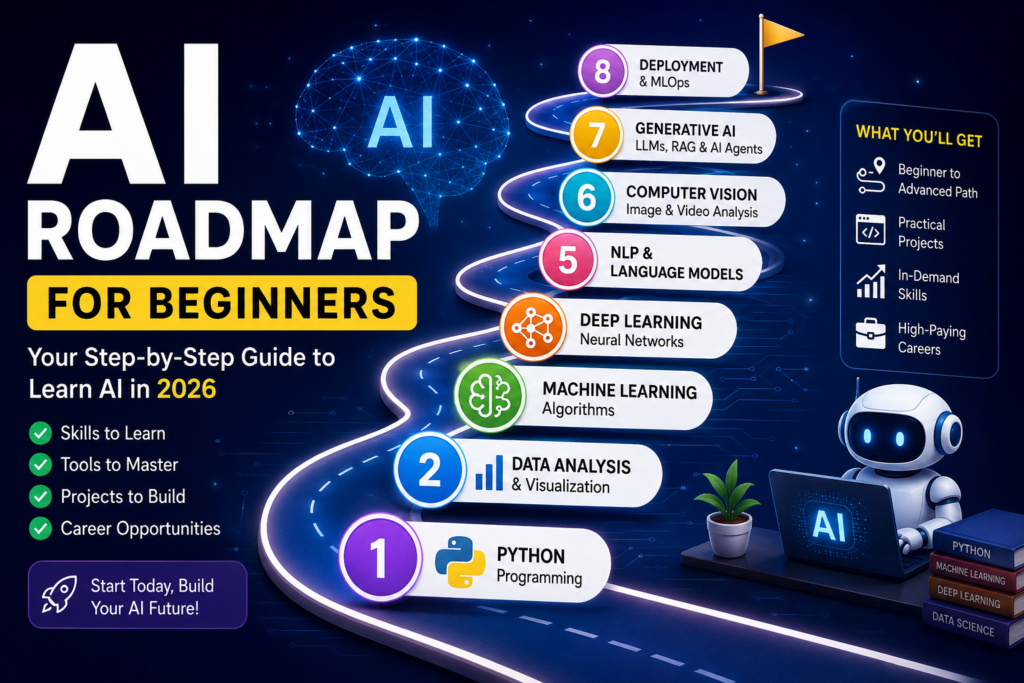
AI Roadmap for Beginners

Artificial Intelligence (AI) is one of the fastest-growing fields in technology. Companies use AI to automate tasks, improve customer experiences, analyze data, and build smart products. From chatbots and recommendation systems to self-driving cars and medical diagnosis tools, AI is changing the way people live and work. As the demand for AI skills continues to rise, many students, developers, and professionals want to learn Artificial Intelligence. However, most beginners face the same problem: they do not know where to start. Should you learn Python first? Do you need advanced mathematics? Is machine learning more important than deep learning? When should you learn Generative AI, Large Language Models (LLMs), or AI agents? This AI roadmap for beginners answers these questions and provides a clear learning path. By following this roadmap, you can avoid common mistakes, focus on the right skills, and build a strong foundation for a career in AI. Why Learn Artificial Intelligence? Artificial Intelligence is creating new opportunities across almost every industry. Businesses need AI professionals who can build models, analyze data, automate processes, and develop intelligent applications. Some of the biggest advantages of learning AI include: High demand for skilled professionals Excellent salary potential Opportunities to work on innovative projects Ability to build smart applications Strong career growth prospects AI skills are valuable in healthcare, finance, education, cybersecurity, e-commerce, manufacturing, and many other industries. Do You Need a Degree to Learn AI? One of the most common questions beginners ask is whether they need a computer science degree to learn AI. The short answer is no. A degree can provide a strong academic foundation, but many successful AI engineers learned through self-study, online courses, open-source projects, and practical experience. Most employers care more about your ability to solve problems and build real-world applications than the specific degree listed on your resume. If you can demonstrate your skills through projects and a strong portfolio, you can compete for many AI-related positions. Understanding AI Career Paths Before you start learning, it is important to understand the different career paths within Artificial Intelligence. Career Path Primary Focus Key Skills AI Engineer Building AI applications Python, ML, Deep Learning Machine Learning Engineer Training and deploying models ML, MLOps, Cloud Data Scientist Data analysis and prediction Statistics, ML NLP Engineer Language-based AI systems Transformers, LLMs Computer Vision Engineer Image and video analysis CNNs, Deep Learning Generative AI Developer AI assistants and chatbots LLMs, RAG, Agents AI Researcher Developing new AI techniques Mathematics, Research Your chosen path may influence which topics you study more deeply, but all beginners should start with the same core foundation. Phase 1: Learn Python Programming Python is the most widely used programming language in Artificial Intelligence. Nearly every AI framework and tool supports Python. Start by learning: Variables Data types Conditional statements Loops Functions Lists Dictionaries Classes and objects File handling Do not rush through Python. Spend time writing small programs and solving coding challenges. Recommended Python Projects Number guessing game Simple calculator To-do list application Password generator Student management system The goal is to become comfortable writing code before moving into AI concepts. Phase 2: Learn Essential Mathematics Many beginners fear mathematics, but you only need a practical understanding of key concepts. Focus on three areas: Linear Algebra Learn: Vectors Matrices Matrix multiplication Linear algebra helps neural networks process information. Statistics Learn: Mean Median Variance Standard deviation Statistics helps you understand data and model performance. Probability Learn: Conditional probability Probability distributions Bayes’ theorem Probability forms the foundation of many machine learning algorithms. Avoid spending months studying advanced mathematical proofs. Learn concepts as you need them. Phase 3: Learn Data Analysis Artificial Intelligence depends on data. Before training models, you must know how to work with datasets. Learn these tools: NumPy Pandas Matplotlib Develop skills in: Data cleaning Data visualization Data exploration Feature analysis Beginner Data Analysis Project Analyze a public dataset and answer questions such as: Which trends exist? Which features matter most? What insights can you discover? This step builds the foundation for machine learning. Phase 4: Learn Machine Learning Machine Learning teaches computers to identify patterns and make predictions. Start by understanding: Features Labels Training data Testing data Overfitting Underfitting Then learn these algorithms: Linear Regression Logistic Regression Decision Trees Random Forest K-Means Clustering Machine Learning Projects House price prediction Spam email detector Student performance predictor Customer churn prediction Machine learning forms the bridge between traditional programming and modern AI systems. Phase 5: Learn Deep Learning and Neural Networks Deep Learning powers many modern AI applications. Important topics include: Artificial neurons Neural networks Activation functions Forward propagation Backpropagation Gradient descent After learning the basics, study: Convolutional Neural Networks (CNNs) Recurrent Neural Networks (RNNs) Transformers Deep Learning Projects Handwritten digit recognition Image classification system Face recognition application These projects help you understand how neural networks solve real-world problems. Phase 6: Learn Computer Vision and NLP Once you understand deep learning, specialize in popular AI domains. Computer Vision Computer vision enables machines to understand images and videos. Applications include: Facial recognition Medical imaging Autonomous vehicles Security systems Natural Language Processing (NLP) NLP allows machines to understand human language. Applications include: Chatbots Translation tools Sentiment analysis Text summarization Learning these fields prepares you for modern AI development. Phase 7: Learn Generative AI Generative AI has become one of the most important areas in Artificial Intelligence. Instead of simply analyzing data, generative models create new content. Topics to learn: Prompt Engineering Large Language Models (LLMs) Context Windows Tokenization Embeddings Fine-Tuning Generative AI skills are now highly valued by employers and businesses. Phase 8: Learn Retrieval-Augmented Generation (RAG) Many modern AI systems use RAG to improve accuracy. RAG allows AI applications to retrieve information from external documents before generating responses. Learn: Embeddings Vector databases Document chunking Retrieval pipelines RAG Project Build a chatbot that answers questions using PDF documents. This project demonstrates practical AI development skills. Phase 9: Learn AI Agents AI agents represent the next stage of AI applications. Unlike traditional chatbots, agents can: Use tools Search information Complete

Scroll to Top