
Featured Articles

RAG Versus Fine-Tuning
Artificial Intelligence, Featured Articles

RAG Versus Fine-Tuning

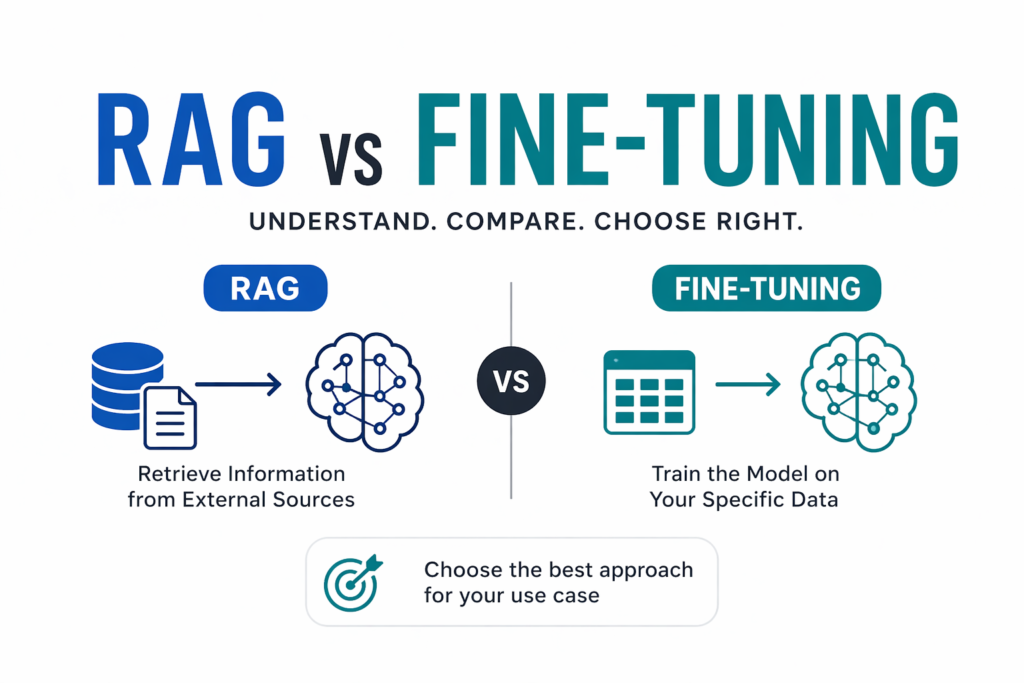
Introduction Let’s talk about RAG versus fine-tuning. Now they’re both powerful ways to enhance the capabilities of large language models, but today you’re going to learn about their strengths, their use cases, and how you can choose between them. So one of the biggest issues with dealing with generative AI right now is one enhancing the models, but also to dealing with their limitations. For example, I just recently asked my favorite llm a simple question, who won the Euro 2024 World Championship, and while this might seem like a simple query for my model, well there’s a slight issue because the model wasn’t trained on that specific information. It can’t give me an accurate or up-to-date answer. At the same time these popular models are very generalistic, and so how do we think about specializing them for specific use cases and adapt them in Enterprise applications. Because your data is one of the most important things that you can work with, and in the field of AI using techniques such as rag or fine-tuning will allow you to supercharge the capabilities that your application delivers. So in the next few minutes we’re going to learn about both of these techniques, the differences between them, and where you can start seeing and using them in. Let’s get started. Retrieval Augmented Generation (RAG) So let’s begin with retrieval augmented generation, which is a way to increase the capabilities of a model through retrieving external and up-to-date information, augmenting the original prompt that was given to the model, and then generating a response back using that context and information. And this is really powerful because if we think back about that example of with the Euro Cup, well the model didn’t have the information in context to provide an answer, and this is one of the big limitations of llms. But this is mitigated in a way with rag because now instead of having an incorrect or possibly a hallucinated answer, we’re able to work with what’s known as a corpus of information. So this could be data, this could be PDFs, documents, spreadsheets, things that are relevant to our specific organization or knowledge that we need to specialize in. So when the query comes in this time, we’re working with what’s known as a retriever that’s able to pull the correct doc doents and Rel relative context to what the question is, and then pass that knowledge as well as the original prompt to a large language model. And with its intuition and pre-trained data, it’s able to give us a response back based on that contextualized information, which is really really powerful because we can start to see that we can get better responses back from a model with our proprietary and confidential information without needing to do any retraining on the model. And this is a great and popular way to enhance the capabilities of a model without having to do any fine-tuning. Fine-Tuning So as the name implies, what this involves is taking a large language foundational model, but this time we’re going to be specializing it in a certain domain or area. So we’re working with labeled and targeted data that’s going to be provided to the model, and and when we do some processing, we’ll have a specialized model for a specific use case to talk in a certain style, to have a certain tone that could represent our organization or company. And so then when a model is queried from a user or any other type of way, we’ll have a a response that gives the correct tone and output or specialty in a domain that we’d like to receive. And this is really important because what we’re doing is essentially baking in this context and intuition into the model. And it’s really important because this is now part of the model’s weights versus being supplemented on top with a a technique like rag. Strengths and Weaknesses of RAG and Fine-Tuning Okay so we understand how both of these techniques can enhance a model’s accur output and performance, but let’s take a look at their strengths and weaknesses in some common use cases because the direction that you go in can greatly affect a model’s performance, its accuracy outputs, compute cost, and much much more. So let’s begin with retrieval augmented generation, and something that I want to point out here is that because we’re working with a corpus of information and data, this is perfect for dynamic data sources such as databases and other data repositories where we want to continuously pull information and have that up to date for the model to use understand. And at the same time because we’re working with this retriever system and passing in the information as context in the prompt, well that really helps with hallucinations, and providing the sources for this information is really important in systems where we need trust and transparency when we’re using AI. So this is fantastic. But let’s also think about this whole system because having this efficient retrieval system is really important in how we select and pick the data that we want to provide in that limited context window. And so maintaining this is also something that you need to think about. And at the same time what we’re doing here in this system is effectively supplementing that information on top of the model, so we’re not essentially enhancing the base model itself, we’re just giving it the relative and contextual information it needs. Fine-Tuning Strengths and Limitations Versus fine-tuning is a little bit different because we’re actually baking in that context and intuition into the model. Well we have greater influence in essentially how the model behaves and reacts in different situations. Is it an insurance adjuster, can it summarize documents, whatever we want the model to do, we can essentially use fine tuning in order to help with that process. And at the same time because
Non-Linearity in Neural Networks?
Artificial Intelligence, Featured Articles, Neural Networks

Why Do We Need Non-Linearity in Neural Networks?

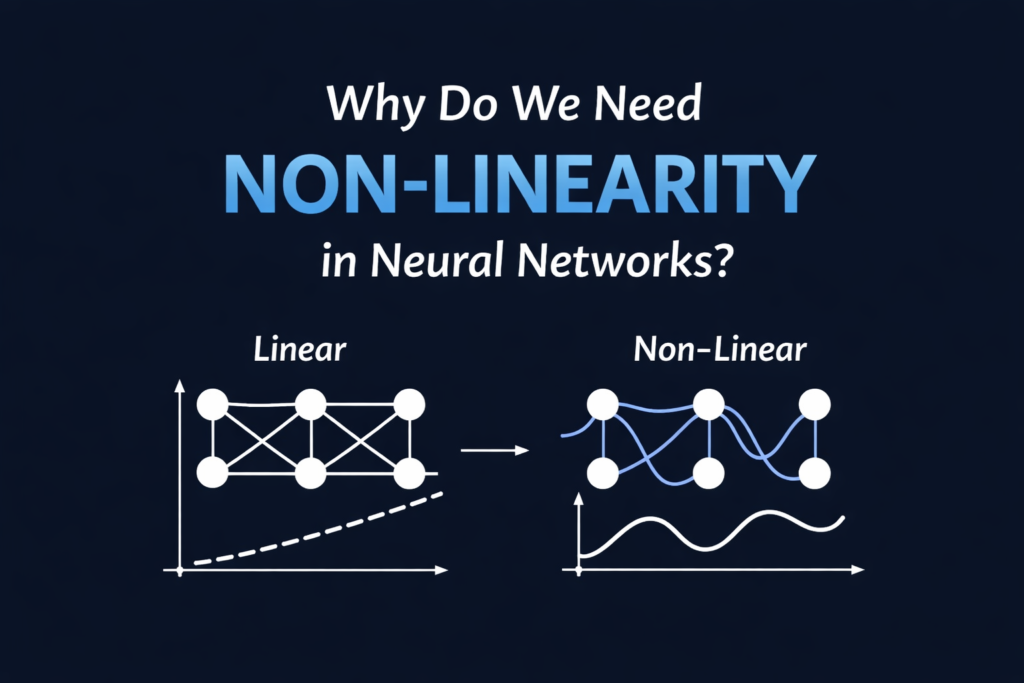
Neural networks are designed to solve problems that normal computer programs and simple mathematical models cannot handle easily. They help machines learn from data and make smart decisions, such as recognizing images, understanding speech, or predicting results. However, neural networks can only perform these tasks successfully when they can learn complex patterns. This is why non-linearity in neural networks plays a very important role. Without non-linearity, a neural network becomes too simple and cannot understand real-world data properly. Why Do We Need Non-Linearity in Neural Networks? Neural networks are one of the most powerful tools in artificial intelligence. They help machines recognize faces, understand speech, translate languages, and even detect diseases. But one question confuses many beginners: Why do we need non-linearity in neural networks? The simple answer is: Without non-linearity, a neural network becomes almost useless because it cannot learn complex patterns. In this article, you will understand non-linearity in the easiest way, with examples and real-world explanations. What Does Non-Linearity Mean? Non-linearity means the output does not increase in a straight-line relationship with the input. If you increase something step by step and the result increases in the same way, that is linear. For example, if 1 hour of work gives you $10, then 2 hours gives you $20, and 3 hours gives you $30. This is a straight-line pattern. In real life, many things do not follow a straight line. For example, when you heat water, it stays liquid for a long time, but at 100°C, it suddenly turns into steam. That is non-linear behavior. Most real-world problems like image recognition, language translation, and disease prediction are non-linear. What is an Activation Function? In neural networks, we add non-linearity using something called an activation function. An activation function is a mathematical function that decides: Should this neuron activate strongly, weakly, or not at all? Popular activation functions include ReLU (Rectified Linear Unit), Sigmoid, Tanh, and Softmax. These functions help neural networks learn complicated relationships. Why Neural Networks Need Non-Linearity (Main Reason) The biggest reason is simple: Without non-linearity, neural networks can only learn straight-line patterns. Even if you add many layers, the network still behaves like a single layer. This means it cannot solve complex problems. What Happens If We Remove Non-Linearity? To understand this, let’s look at what happens when we use only linear functions. A neuron usually works like this: Output = (weights × inputs) + bias. This is a linear equation. Now imagine a network with multiple layers but no activation function. Layer 1: y = W1x + b1. Layer 2: z = W2y + b2. Substitute y into layer 2: z = W2(W1x + b1) + b2. z = (W2W1)x + (W2b1 + b2). This is still a linear equation. So even if you use 10 layers, the final output remains linear. A deep network without activation functions behaves like a simple linear model, so it cannot learn complex shapes or decision boundaries. Real Life Example: Why Linear Models Fail Imagine you want a neural network to separate two groups of points. If the points can be separated using a straight line, a linear model can solve it. But many datasets cannot be separated using a straight line. A good example is the famous XOR problem. The XOR Problem The XOR problem is one of the most famous reasons why non-linearity matters. XOR logic works like this: if both inputs are the same, the output is 0, and if the inputs are different, the output is 1. A linear model cannot solve XOR because no single straight line can separate output 1 from output 0. But a neural network with a non-linear activation function can solve it easily. This happens because non-linearity allows the network to create curved boundaries instead of straight lines. Non-Linearity Helps Neural Networks Learn Complex Patterns Most real-world tasks need the network to learn patterns like curves, circles, waves, and irregular shapes. For example, an image contains pixels, shadows, edges, and textures. A linear model cannot understand these complex features properly. But a neural network with non-linearity can learn edge detection, object shape, facial features, and background difference. This is why deep learning works so well in computer vision. Non-Linearity Makes Deep Learning Powerful Deep learning means using many hidden layers. But layers only become useful when they learn different types of features. For example, a deep neural network learns a cat image step by step. The first layer learns edges, the second layer learns shapes like circles and curves, the third layer learns eyes, ears, and tail, and the final layer recognizes the cat. This learning becomes possible only because activation functions add non-linearity. Without non-linearity, each layer would repeat the same type of learning. Non-Linearity Creates Better Decision Boundaries A decision boundary is the line or shape that separates one class from another. A linear model creates a straight-line decision boundary. But a neural network with non-linearity can create curves, circles, and complex shapes. This makes neural networks powerful for classification problems like spam vs not spam, cancer vs non-cancer, dog vs cat, and fraud vs normal transactions. Non-Linearity Helps Neural Networks Approximate Any Function One important idea in deep learning is that neural networks can approximate almost any function. This is called the Universal Approximation Theorem. But this is only true if we use non-linear activation functions. If the network stays linear, it cannot represent complex functions. Non-linearity helps the network behave like a flexible system that can model almost any real-world relationship. Why Can’t We Use Only One Non-Linear Layer? You may ask: If one non-linear layer is enough, why do we need many layers? The answer is simple: deep networks learn better and faster for complex tasks. Many layers allow the network to break a hard problem into smaller parts. This is similar to how humans solve complex problems step by step. Each layer learns a small part, and together they solve the full problem. Common Activation Functions That Add Non-Linearity ReLU (Rectified

Scroll to Top