
Applications of Reinforcement Learning: 10 Real-World Examples
Explore 10 real-world applications of reinforcement learning, from robotics to healthcare and LLMs. See how agents, rewards, and actions work in each one.
 Nov 10, 2026Published
16 min readReading time
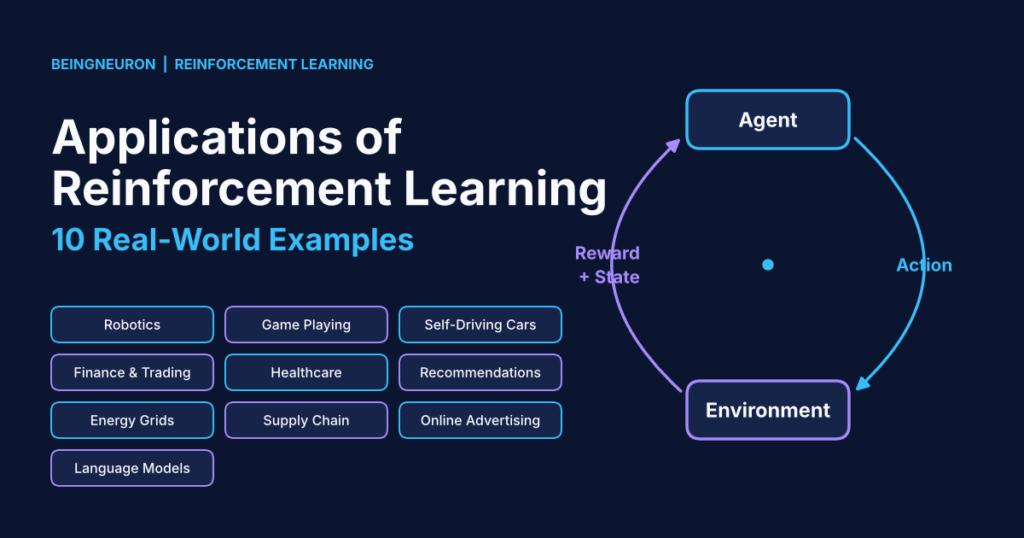
Reinforcement learning (RL) trains software to make decisions through trial, feedback, and improvement. Instead of studying labeled examples, an RL agent acts, sees what happens, and adjusts. That makes it a natural fit for problems where today’s choice changes tomorrow’s options: steering a robot, timing traffic lights, or tuning a language model’s replies.
This guide covers the main applications of reinforcement learning and the mechanics behind each one: who the agent is, what it can do, and what it is rewarded for. You will see 10 real-world examples, how deep RL extends the idea, and where the limits are. Throughout, we separate documented research from commercial deployment, because the two are easy to confuse. If you are new to the basics, start with What Is Reinforcement Learning? A Complete Guide.
What Is Reinforcement Learning?
Reinforcement learning is a branch of machine learning in which an agent learns to choose actions by interacting with an environment and receiving rewards (Sutton and Barto, 2018). Five terms cover most of what you need:
- Agent: the decision-maker that learns.
- Environment: everything the agent interacts with.
- State: a description of the current situation.
- Action: a choice the agent can make.
- Reward: a number that scores the result of an action.
The agent follows a policy, a rule that maps states to actions. Learning is a loop: observe the state, pick an action, receive a reward and a new state, then update the policy. The goal is to maximize cumulative reward, not just the next reward.
A simple example: a warehouse robot learns to deliver packages. It starts out bumping into shelves. Over many attempts it learns that certain routes earn rewards faster and avoid penalties, and its behavior improves.
This differs from the supervised learning behind most traditional machine learning applications. A spam filter predicts one label for one email, and no prediction changes the next email. An RL agent chooses a sequence of actions, and each action changes what happens next. For a deeper comparison, see Reinforcement Learning vs Supervised Learning.
How Does Reinforcement Learning Work in Real-World Applications?
Every application follows the same pattern. The agent observes the environment’s state and sends an action. The environment responds with a reward and a new state. The cycle repeats thousands or millions of times. For more on the learner’s side of this loop, see What Is an Agent in Reinforcement Learning?
Actions produce outcomes, and outcomes produce rewards. Because the agent cares about long-term results, it estimates the return: the discounted sum of future rewards.
Gt = rt+1 + γ rt+2 + γ2 rt+3 + …
Here γ (between 0 and 1) is the discount factor. A smaller value makes the agent favor near-term rewards. Through repeated interaction, the agent shifts its policy toward actions that lead to higher returns. For the full mechanics, read How Does Reinforcement Learning Work?
In real applications, the trial and error rarely happens on the real system, because mistakes are costly. Teams usually train in a simulator or from logged data, test against safety rules, and only then try limited real-world use.
Here is the warehouse robot from earlier, written out as states, actions, and rewards. The numbers are illustrative.
| Element | In the warehouse example |
|---|---|
| State | Robot position, battery level, nearby obstacles, package location |
| Actions | Move forward, turn left, turn right, stop, pick up, drop off |
| Rewards | +10 for a correct delivery, −1 per step (encourages short routes), −50 for a collision |
| Learning result | A policy that reaches the package by a short, collision-free route |
10 Real-World Applications of Reinforcement Learning
The map below shows where RL appears. Each application that follows names the agent, environment, actions, and rewards, then separates documented examples from hype.
Learns motor control
Learns driving decisions
Supports treatment planning
Allocates and trades
Learns strategy by self-play
Adapts to user feedback
Aligns with human feedback
Schedules and controls
Times signals
Balances supply and demand
1. Robotics
The problem: hand-coding control rules for every grasp, step, or obstacle is brittle. RL suits robotics because movement is sequential, rewards often arrive late (a grasp succeeds only at the end), and physics is hard to model exactly. It covers navigation, robotic arm control, and complex physical movements such as walking.
Agent: the robot’s controller. Environment: the robot’s body, objects, and physics. Actions: joint torques, velocities, gripper commands. Reward: progress toward the goal, minus penalties for falls or wasted energy.
Documented research: Hwangbo et al. (2019) trained a legged robot’s controller in simulation and ran it on the real machine. OpenAI (2019) trained a robot hand to manipulate a Rubik’s Cube, with limited success on hard scrambles. Google’s QT-Opt learned grasping from hundreds of thousands of real attempts.
Challenges: real robots collect data slowly (poor sample efficiency), exploratory moves can damage hardware, and policies trained in simulation often degrade in reality (the sim-to-real gap).
2. Autonomous Vehicles
The problem: driving means continuous decisions among unpredictable road users. RL fits decisions such as merging, yielding, and lane changing, where the best action depends on long-term consequences and adaptive driving strategies must handle varied traffic.
Agent: the driving policy (or one module, such as a lane-change planner). Environment: roads, vehicles, pedestrians, and traffic rules. Actions: steering, acceleration, braking, or higher-level moves like “change lane.” Reward: safe progress, minus penalties for collisions, hard braking, and rule violations.
Documented research: Kendall et al. (2018) used deep RL to teach a real car lane following from camera images, and Shalev-Shwartz et al. (2016) proposed RL for multi-agent driving with safety constraints. Publicly documented RL driving work is mostly research. Production systems rely heavily on other methods.
Why simulation matters: crashes are unacceptable, and rare events like sudden cut-ins are too infrequent to learn from on real roads. Simulators such as CARLA let an agent practice them millions of times safely. Challenges: simulator realism, rare edge cases, and proving safety to regulators.
3. Healthcare and Medical Treatment
The problem: treatment unfolds over time. A clinician adjusts doses as a patient’s condition changes, and today’s choice affects tomorrow’s options. RL can support personalized treatment planning and adaptive treatment strategies. It has also been studied for patient monitoring, such as adapting when to alert staff. It does not replace doctors. It offers decision support that clinicians review.
Agent: a decision-support policy. Environment: the patient and care setting. Actions: treatment options, such as dose ranges. Reward: better outcomes (stability, survival), minus penalties for adverse events.
Documented research: Komorowski et al. (2018) trained an “AI Clinician” on intensive care records to suggest sepsis treatments. The evaluation was retrospective, using historical data, not a trial on live patients. Gottesman et al. (2019) published guidelines for the careful use of RL in healthcare.
Challenges: an agent cannot freely experiment on patients, so it must learn from past records that are incomplete and biased. Long-term outcomes make rewards hard to define. Clinical safety, data quality, and human oversight are essential, along with regulatory validation.
4. Finance and Algorithmic Trading
The problem: investors make sequential choices under uncertainty. RL fits because actions have lasting effects (holdings, transaction costs) and the goal is long-run, risk-aware performance. Uses include portfolio optimization, asset allocation, trading strategies, and risk management.
Agent: a trading or allocation policy. Environment: the market (usually replayed from historical data) and the portfolio. Actions: buy, sell, hold, or set target portfolio weights. Reward: return minus transaction costs, often adjusted for risk, with penalties for large losses or excess exposure.
Documented research: Jiang et al. (2017) proposed a deep RL framework for portfolio management, tested on cryptocurrency data. Firms may use RL internally, but public evidence of large-scale commercial deployment is limited.
Challenges: markets change over time, so past patterns may not hold. Signals are noisy, backtests can overfit, and a simulator cannot fully capture how your own trades move prices.
5. Gaming and Game AI
The problem: games have enormous numbers of possible positions, and hand-written evaluation rules are weak. RL fits because games give a clear reward (win or lose) and allow unlimited practice.
Agent: the game-playing program. Environment: the game and its opponent. Actions: legal moves. Reward: +1 for a win, −1 for a loss, 0 for a draw, or the game score.
Documented research: DQN learned 49 Atari games from screen pixels and scores (Mnih et al., 2015). AlphaGo combined learning from human games, RL through self-play, and tree search to beat world-class Go players (Silver et al., 2016). AlphaZero then learned chess, shogi, and Go from self-play, given only the rules (Silver et al., 2018).
Self-play means the agent trains against copies of itself, so the opponent improves as the agent does. Challenges: huge compute needs, and these systems depend on known rules and fast simulators that real-world problems rarely offer.
6. Recommendation Systems
The problem: deciding what to show a user next. A static recommender ranks items by predicted clicks, treating each impression separately. An adaptive recommender treats recommendations as a sequence and aims for long-term engagement or satisfaction. That is sequential decision-making, which is why RL fits.
Agent: the recommendation policy. Environment: users and the item catalog. Actions: which item or list to show. Reward: user engagement signals such as clicks, watch time, or purchases.
Documented research: Shani et al. (2005) modeled recommendation as a sequential decision process. Chen et al. (2019) described a policy-gradient recommender and reported gains in live experiments on YouTube.
Challenges: logged data comes from earlier policies and is biased. Engagement is an imperfect proxy for satisfaction, and optimizing it can favor clickbait. Rewards are noisy and delayed.
7. Natural Language Processing and Large Language Models
The problem: a pretrained language model predicts likely text, but that does not guarantee helpful, honest, or safe answers. “A good response” is hard to write as a formula. Reinforcement learning from human feedback (RLHF) handles this in three steps:
- Humans compare pairs of model responses and pick the better one.
- A reward model is trained to predict those preferences.
- The language model is fine-tuned with RL to earn higher reward-model scores. Policy optimization methods such as PPO do this, usually with a penalty that keeps the model close to its original behavior.
Agent: the language model. Environment: the prompt and conversation. Actions: the words (tokens) it generates. Reward: the reward-model score.
Documented research: Christiano et al. (2017) introduced learning from human preferences, and Ouyang et al. (2022) applied RLHF in InstructGPT. Their human evaluators preferred outputs from a 1.3-billion-parameter InstructGPT model over those of the 175-billion-parameter GPT-3.
Challenges: a reward model is only a proxy, so the model can learn to exploit its flaws (reward hacking). Human labels are costly and subjective, and RLHF does not guarantee factual accuracy.
8. Industrial Automation and Manufacturing
The problem: factories must schedule jobs, allocate resources, and control processes as conditions change. RL fits because decisions are sequential, the dynamics are complex, and simulated plants (“digital twins”) allow safe training. Goals include production optimization, robotic process control, and energy efficiency.
Agent: a scheduler or controller. Environment: the production line or plant. Actions: assign a job to a machine, adjust a setpoint, move a robot. Reward: throughput, minus delays, scrap, and energy use.
Documented research: Waschneck et al. (2018) applied deep RL to production scheduling in a semiconductor factory setting, and Mao et al. (2016) used it for cluster resource allocation (DeepRM). Degrave et al. (2022) trained a controller for plasma shape in a tokamak fusion experiment. These are research results, not evidence of routine factory use.
Challenges: simulator fidelity, hard safety limits, and the cost of downtime during exploration. Classical controllers remain strong, well-understood baselines.
9. Traffic Management and Smart Cities
The problem: fixed-timing traffic signals cannot adapt to changing demand. RL enables adaptive traffic signal control that reacts to current conditions to optimize traffic flow and reduce congestion.
Agent: a signal controller at each intersection. Environment: the road network and its vehicles. Actions: keep the current phase or switch to the next one. Reward: the negative of total waiting time or queue length.
Documented research: IntelliLight (Wei et al., 2018) tested deep RL signal control on real traffic data from China. Chu et al. (2019) used multi-agent deep RL for large-scale signal control in simulated city networks.
Coordination: one intersection’s decision changes the traffic arriving at its neighbors, so multi-agent methods let intersections share information. Challenges: scaling to hundreds of intersections, sensor quality, and enforcing hard rules such as minimum green times. Most results come from simulation.
10. Energy Management and Smart Grids
The problem: grids must balance supply and demand moment by moment, while solar and wind output fluctuates. RL fits because decisions such as charging a battery now affect what is possible later, supporting energy consumption optimization, battery management, and renewable energy integration.
Agent: a controller for a building, battery, or microgrid. Environment: the grid or building, weather, and electricity prices. Actions: charge, discharge, adjust heating or cooling setpoints. Reward: lower cost, with penalties for unmet demand, discomfort, and battery wear.
Documented research: the review by Vázquez-Canteli and Nagy (2019) in Applied Energy surveys RL for demand response, and most studies it covers are simulations. The open-source CityLearn environment supports multi-agent research on this problem.
Challenges: safety-critical constraints, forecast errors, limited real data, and regulation.
Comparison of RL Applications
| Application | Agent | Typical reward | Evidence level |
|---|---|---|---|
| Robotics | Robot controller | Task progress, minus falls and energy | Research and lab demonstrations |
| Autonomous vehicles | Driving policy | Safe progress, minus collisions | Research and simulation |
| Healthcare | Treatment-support policy | Patient outcomes, minus adverse events | Retrospective research |
| Finance | Trading or allocation policy | Risk-adjusted return | Research; limited public evidence of deployment |
| Gaming | Game-playing program | Win, loss, or score | Landmark research results |
| Recommendations | Recommendation policy | Engagement signals | Published industry experiments |
| Language models | The language model | Reward-model score | Widely used in fine-tuning |
| Industrial automation | Scheduler or controller | Throughput, minus delay and energy | Research, mostly in simulation |
| Traffic management | Signal controller | Negative waiting time | Mostly simulation studies |
| Energy and grids | Energy controller | Lower cost, met demand | Mostly simulation studies |
Applications of Deep Reinforcement Learning
Classic RL stores a value for each state-action pair in a table. That works for a few hundred states but fails for camera images or sensor streams. Deep reinforcement learning replaces the table with a neural network that generalizes across similar states. The network turns raw inputs such as pixels, sensor readings, or text into values or actions. (For background, see Multilayer Perceptron.)
Three algorithms appear throughout the applications above:
- DQN (Deep Q-Network): a network that predicts the value of each possible action. It uses experience replay and a target network for stable training, and it suits discrete choices like game controls (Mnih et al., 2015).
- PPO (Proximal Policy Optimization): a policy-gradient method that limits how far each update can move the policy, which keeps training stable. It is common in RLHF and many control tasks (Schulman et al., 2017).
- SAC (Soft Actor-Critic): a method for continuous actions that rewards the agent for staying exploratory as well as earning reward. It is popular in robot control (Haarnoja et al., 2018).
Deep RL is most useful when inputs are high-dimensional (images, text), actions are continuous (joint torques), or a good simulator can supply large amounts of experience.
Advantages of Reinforcement Learning in Real-World Applications
- Learning through interaction: it needs a reward signal, not a labeled dataset of correct actions.
- Adaptive decision-making: policies can respond to changing conditions, such as shifting traffic.
- Sequential optimization: it weighs long-term consequences, not just the next outcome.
- Handling complex environments: it can learn behavior in settings too intricate to hand-code.
- Continuous improvement: a policy can keep learning as new experience arrives, with proper safeguards.
Challenges and Limitations of Reinforcement Learning
- Sample inefficiency: agents often need millions of interactions, which is impractical on real systems.
- Reward engineering: agents maximize the reward as written, which may differ from what you intended (Amodei et al., 2016).
- Exploration risks: trying unknown actions can be unsafe or expensive (García and Fernández, 2015).
- Training costs: deep RL can demand heavy compute and careful tuning.
- Generalization: a policy may fail when conditions differ from training.
- Safety and interpretability: it is hard to explain or guarantee a learned policy’s behavior.
Dulac-Arnold et al. (2021) give a thorough account of these real-world obstacles.
Future of Reinforcement Learning Applications
Several directions are active research areas, not settled outcomes:
- Robotics: combining large pretrained models with RL and simulation to speed up learning.
- AI agents: training language-model agents with rewards that can be checked automatically, such as correct code or math answers. The DeepSeek-R1 report describes RL used to improve reasoning.
- Healthcare: safer evaluation methods and learning from historical data, with clinicians in control.
- Autonomous systems: better simulation, safety constraints, and verification.
- Foundation models: RL as a way to tune and align large models, as RLHF already does.
Frequently Asked Questions
What are the applications of reinforcement learning?
Reinforcement learning is applied to robotics, autonomous driving, healthcare decision support, finance, game playing, recommendation systems, language model alignment, industrial automation, traffic control, and energy management. Each involves sequential decisions where feedback guides improvement.
What are some real-world applications of reinforcement learning?
Documented examples include AlphaGo and AlphaZero in games, RLHF for tuning language models like InstructGPT, and recommendation research at YouTube. Others, such as robot grasping and traffic signal control, are mainly research demonstrations.
Which industries use reinforcement learning?
Technology, robotics, automotive, healthcare, finance, manufacturing, transportation, and energy all explore it. The depth of real use varies widely, so check whether a claim describes research or deployment.
Is ChatGPT an example of reinforcement learning?
Partly. ChatGPT is a large language model first trained to predict text. OpenAI stated it was then fine-tuned with RLHF. RL is one training stage, not the whole system.
How is reinforcement learning used in robotics?
Robots learn control policies, such as walking or grasping, by earning rewards for progress and penalties for failures. Most training happens in simulation first, then transfers to hardware.
What is the difference between RL and deep RL?
Classic RL uses tables or simple functions to store values. Deep RL uses neural networks, so it can handle complex inputs like images and continuous actions.
What is the most common application of reinforcement learning?
It depends on how you count. Games and simulated control tasks dominate research benchmarks. In deployed products, RLHF for tuning language models is arguably the most widespread use today.
Explore reinforcement learning alongside supervised and unsupervised approaches in our guide to machine learning models.
Conclusion
Reinforcement learning lets systems make decisions through interaction and feedback. An agent acts, receives rewards, and refines its policy, which is why the same idea appears in game-playing programs, robots, language models, and traffic lights. The strongest evidence today sits in games and language model tuning. Most other applications remain research or pilots, limited by safety, data, and cost. To continue the learning path, read Reinforcement Learning vs Supervised Learning next.
References and Further Reading
- Sutton, R. and Barto, A. (2018). Reinforcement Learning: An Introduction, 2nd ed., MIT Press.
- Mnih et al. (2015). Human-level control through deep reinforcement learning. Nature.
- Silver et al. (2016). Mastering the game of Go with deep neural networks and tree search. Nature.
- Silver et al. (2018). A general reinforcement learning algorithm that masters chess, shogi, and Go through self-play. Science.
- Ouyang et al. (2022). Training language models to follow instructions with human feedback.
- Komorowski et al. (2018). The Artificial Intelligence Clinician learns optimal treatment strategies for sepsis in intensive care. Nature Medicine.
- Dulac-Arnold et al. (2021). Challenges of real-world reinforcement learning. Machine Learning.