
What Is Reinforcement Learning? A Complete Guide
Reinforcement learning (RL) trains an agent to make decisions by interacting with an environment and maximizing reward. Learn the core components, main algorithms, applications, and how to start.
 Nov 6, 2026Published
10 min readReading time
Imagine a robot at the entrance of a maze. It has no map, no list of correct moves, and no idea where the exit is. It tries a direction, hits a wall, tries another, and slowly learns which choices lead out. That process of improving through experience and feedback is the core of reinforcement learning.
This guide explains what reinforcement learning is, how its parts fit together, which algorithms matter, where it is used, and where it struggles. It is the main guide in BeingNeuron’s reinforcement learning series, and each section points to a deeper article when you want more detail.
What Is Reinforcement Learning?
Reinforcement learning (RL) is a machine learning approach in which an agent learns to make decisions by interacting with an environment and receiving rewards. The agent’s goal is to maximize the total reward it collects over time.
Three ideas set RL apart from other kinds of machine learning:
- Learning from interaction. The agent creates its own experience by acting, instead of studying a fixed collection of examples.
- Evaluative feedback. The environment signals how good an outcome was (a reward). It does not say which action would have been correct.
- Delayed consequences. An action can affect rewards many steps later, so the agent must learn to link decisions to long-term results.
Richard Sutton and Andrew Barto, authors of the standard textbook Reinforcement Learning: An Introduction, describe RL as learning what to do in order to maximize a numerical reward signal, without being told which actions to take.
How Does Reinforcement Learning Work?
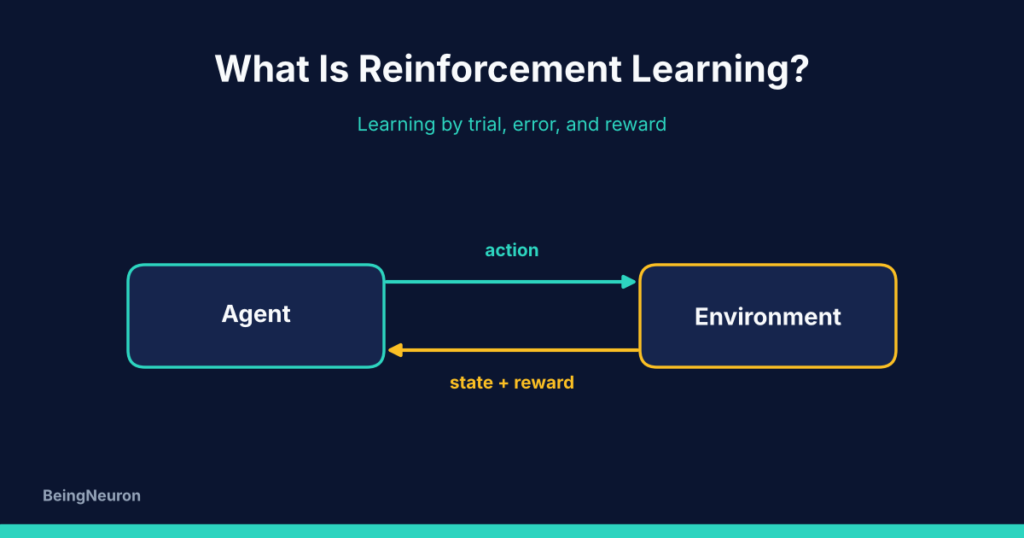
RL works as a loop. The agent observes the current situation, picks an action, and the environment responds with a new situation and a reward. The agent uses that reward to adjust how it chooses actions next time. Repeating this loop thousands or millions of times gradually produces better behavior.
The mechanics are covered step by step in How Does Reinforcement Learning Work?
The Main Components of Reinforcement Learning
Agent
The agent is the learner and decision-maker. It could be a program playing a game or the control software of a robot. See What Is an Agent in Reinforcement Learning? for a closer look.
Environment
The environment is everything the agent interacts with but does not directly control: a maze, a game, a simulator, or a physical room. It reacts to each action with a new situation and a reward.
State
A state describes the situation at a given moment, such as the robot’s position in the maze. In many problems the agent sees only an observation, which may be a partial view of the true state.
Action
An action is a choice the agent can make: move up, down, left, or right. Action spaces can be discrete (a fixed list of choices) or continuous (for example, a motor torque).
Reward
The reward is a number sent by the environment after each step. It defines the goal. Positive values encourage behavior and negative values discourage it. The agent maximizes the sum of rewards over time, not just the next reward.
Policy
The policy is the agent’s rule for choosing actions. Written as π(a | s), it gives the probability of taking action a in state s. Learning in RL means improving the policy.
The Reinforcement Learning Process
RL problems are usually formalized as a Markov decision process (MDP): a set of states, a set of actions, rules for how the environment moves between states, a reward function, and a discount factor. The Markov property means the current state contains all the information needed to predict what happens next.
The agent does not just chase the next reward. It tries to maximize the return, the discounted sum of future rewards:
Gt = rt+1 + γ·rt+2 + γ²·rt+3 + …
- Gt: the return from time step t.
- rt+1: the reward received after the action at step t.
- γ (gamma): the discount factor, between 0 and 1. A value near 0 makes the agent short-sighted. A value near 1 makes it value the long term.
With γ = 0.9, a reward of +10 that arrives as the third reward in the sequence counts as 0.9² × 10 = 8.1 today. Interactions are often grouped into episodes, each running from a start state to an ending such as reaching the goal.
How an Agent Learns Through Trial and Error
Take a 3×3 maze. The agent starts in the bottom-left cell and the goal is in the top-right cell. A wall blocks the center cell. The agent gets −1 for each move and +10 for the move that reaches the goal.
In early episodes the agent knows nothing, so it moves almost at random and may wander for many steps. Because each step costs −1, wandering produces a poor total. Occasionally it stumbles into the goal and receives +10. The agent then faces the credit assignment problem: which of the many earlier moves deserves credit for that reward?
RL algorithms solve this by passing value backward. The cell next to the goal becomes valuable, then the cell before it, and so on. Over many episodes the agent builds estimates of how good each action is in each state and starts to prefer the better ones.
Learning also requires exploration versus exploitation. Exploitation means choosing the action that currently looks best. Exploration means trying something else in case it is better. A common approach, epsilon-greedy, picks a random action with a small probability ε and the best-known action otherwise.
Types of Reinforcement Learning
RL methods are grouped along several overlapping axes, so one algorithm can belong to more than one group.
| Type | What it learns | Example algorithms |
|---|---|---|
| Model-free | Behavior directly from experience, without learning how the environment works | Q-learning, SARSA, DQN, PPO |
| Model-based | A model of how states and rewards change, used to plan ahead | Dyna-Q, MuZero |
| Value-based | Value estimates for states or actions; the policy picks the highest value | Q-learning, SARSA, DQN |
| Policy-based | The policy itself, adjusted to increase expected return | REINFORCE, policy gradients |
| Actor-critic | A policy (actor) and a value estimate (critic) trained together | A2C, DDPG, PPO |
Model-based methods can need less real experience because they can plan inside a model, but errors in the model can mislead the agent. Model-free methods are simpler to apply but often need far more interaction.
Major Reinforcement Learning Algorithms
Q-Learning
Q-learning learns a table of Q-values, where Q(s, a) estimates the return from taking action a in state s and acting well afterward. After each step it applies this update:
Q(s, a) ← Q(s, a) + α [ r + γ · maxa′ Q(s′, a′) − Q(s, a) ]
Here α is the learning rate, r is the reward, s′ is the next state, and the max term is the best Q-value available there. Q-learning is off-policy: it learns about the greedy policy even while the agent explores.
SARSA
SARSA (state, action, reward, state, action) is almost identical but uses the action a′ the agent actually takes next instead of the maximum. This makes it on-policy, so its values reflect the exploration it really does, which can lead to more cautious behavior near risky states.
Deep Q-Networks (DQN)
DQN replaces the Q-table with a neural network so the agent can handle huge state spaces such as raw game pixels. DeepMind’s 2015 Nature paper showed this on Atari games. Two ideas keep training stable: experience replay (learning from random samples of stored transitions) and a target network (a slowly updated copy of the network used to compute targets). DQN suits discrete actions.
PPO (Proximal Policy Optimization)
PPO is a policy-gradient method. It collects experience with the current policy, then updates it using a clipped objective that stops each update from changing the policy too much. This makes training more stable, and PPO is a common default. See the original paper.
A2C (Advantage Actor-Critic)
A2C trains an actor (the policy) and a critic (a value estimate). The critic helps compute the advantage: how much better an action turned out than expected. A2C is the synchronous variant of A3C, collecting experience from several environment copies before each update.
DDPG (Deep Deterministic Policy Gradient)
DDPG is an off-policy actor-critic method for continuous actions. The actor outputs one specific action, the critic scores it, and noise is added during training for exploration. It uses a replay buffer and target networks like DQN. See the DDPG paper.
Reinforcement Learning vs Other Machine Learning Approaches
| Supervised | Unsupervised | Reinforcement | |
|---|---|---|---|
| Learns from | Labeled examples | Unlabeled data | Interaction and rewards |
| Goal | Predict labels or values | Find structure | Choose actions that maximize return |
| Feedback | Correct answer per example | No target answers | Reward, often delayed |
For details, read Reinforcement Learning vs Supervised Learning and Reinforcement Learning vs Unsupervised Learning. If those terms are new, start with What Is Supervised Learning? and What Is Unsupervised Learning?
Real-World Applications
- Games: DQN played Atari games, and DeepMind’s AlphaGo (which combined supervised learning from human games with RL self-play) defeated top Go players.
- Robotics: RL trains walking, grasping, and manipulation skills, often in simulation first.
- Language model alignment: Reinforcement learning from human feedback (RLHF) fine-tunes language models using a reward model trained on human preferences, as in InstructGPT.
- Control and resource allocation: RL has been applied to energy systems, scheduling, and network management, with results varying by setting.
- Recommendation: Treating a user session as a sequence of decisions is an active research and engineering area.
Advantages and Limitations of Reinforcement Learning
Advantages
- Handles sequential decisions where actions affect future situations.
- Needs no labeled examples of correct actions.
- Can discover strategies humans did not design.
- Adapts to changing conditions when it keeps learning.
Limitations
- Often needs large amounts of interaction (poor sample efficiency).
- Results depend heavily on reward design and hyperparameters.
- Training can be unstable and hard to reproduce.
- Learning by trial and error is risky in safety-critical settings.
Challenges in Reinforcement Learning
Reward design
Agents optimize the reward you write, not the goal you intended. In a widely cited example, an agent in a boat-racing game learned to circle and collect bonus items instead of finishing the race. This is called reward hacking.
Exploration
When rewards are rare, an agent may never find them by random exploration.
Sample efficiency and stability
Deep RL can need millions of steps, and small changes in settings or random seeds can change results.
Safety and sim-to-real transfer
Mistakes during learning can damage hardware. Policies trained in simulation may fail when simulation and reality differ.
How to Start Learning Reinforcement Learning
- Build the basics. Learn Python and core machine learning ideas. The AI Roadmap for Beginners is a good starting point.
- Review probability and a little calculus. Expectations and derivatives appear throughout RL.
- Read the first chapters of Sutton and Barto. The free online book covers bandits, MDPs, and temporal-difference learning.
- Implement tabular Q-learning. Use the Gymnasium library on a small problem such as FrozenLake.
- Move to deep RL. Try Stable-Baselines3 and study OpenAI’s Spinning Up introduction.
Frequently Asked Questions
Is reinforcement learning supervised or unsupervised?
Neither. It is usually treated as a third paradigm because feedback comes as rewards from interaction, not labels or the absence of targets.
What is deep reinforcement learning?
Deep RL uses neural networks to represent the policy, the value function, or both. DQN and PPO are examples.
Does reinforcement learning need a dataset?
Standard online RL creates its own data by interacting with an environment. Offline RL instead learns from a fixed log of past interactions.
Is ChatGPT trained with reinforcement learning?
Modern chat models are first trained on large text collections and then commonly refined with methods that include reinforcement learning from human feedback. RL is one stage, not the whole process.
What tools are used for RL?
Python with Gymnasium for environments and libraries such as Stable-Baselines3 for algorithms are the usual starting points.
Conclusion
Reinforcement learning teaches an agent to act by rewarding good outcomes and letting it learn from experience. Its main parts are the agent, environment, state, action, reward, and policy, and its main algorithm families differ in what they learn: values, policies, or both. RL is powerful for sequential decisions but demands careful reward design and a lot of experience. Continue with How Does Reinforcement Learning Work? for the learning loop in detail.